Ball Catcher: Studying Live Collaboration in Augmented Reality
- Nov 29, 2021
- 3 min read
Updated: Jan 2
Ball Catcher is an augmented reality game that enables users to play, connect, and collaborate in real time from remote locations. The game is designed around synchronous interaction, allowing players to work together through shared tasks and active manipulation of the game environment. Players can interact both with each other and with dynamic environmental elements, which respond directly to their actions.
This research explores player to player and player to game interactions within remote AR environments. The project involved extensive requirement gathering, ideation, and iterative prototyping. Ball Catcher introduces novel interaction mechanisms suited for synchronous multiplayer experiences in AR. The findings aim to support game designers and researchers interested in building collaborative experiences in remote AR settings.
The project was selected for presentation at the India HCI 2021 Conference. The complete research report can be accessed here.
Research Process
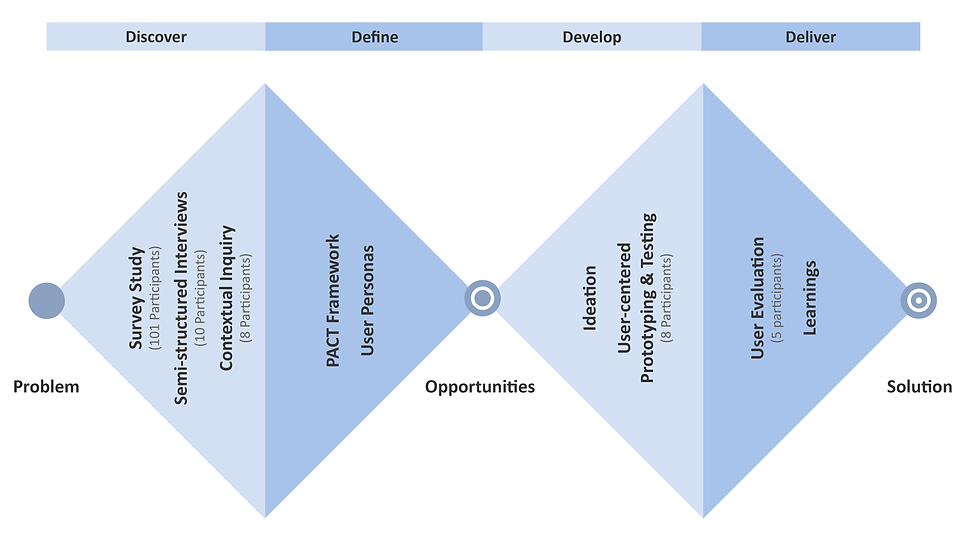
We adopted an iterative design approach using the Double Diamond framework to structure our research and prototyping efforts.
In the Discover phase, we developed a foundational understanding of the problem through surveys, semi structured interviews, and contextual interviews. In the Define phase, insights from the discovery stage were synthesized to identify and refine the core challenges.
The Development phase focused on divergent thinking, where we ideated extensively to explore multiple interaction possibilities. Finally, in the Deliver phase, we converged on a solution by building a functional prototype and conducting user evaluations.
Participants across all stages were recruited using purposive sampling. Studies were conducted with participants aged 13 to 24 years, as teenagers and young adults form the primary demographic for casual games. Prior consent was obtained for recording survey responses and interactions, and assent was taken from minor participants along with parental consent.
Prototyping and Output
We followed an iterative prototyping process, beginning with low fidelity prototypes to rapidly explore ideas. After initial validation, we progressed to a high fidelity programmed prototype.
For the low fidelity stage, we used a user driven prototyping approach to maximize player input during design. Concepts were demonstrated using animations, modified gameplay videos from existing games, and storyboards. The prototype was piloted with eight participants, five male and three female, with a median age of 20 years. Half of the participants were regular gamers, while the rest were occasional players. None had participated in earlier stages of the research.
This phase revealed two key insights. First, participants found synchronous collaboration more engaging than individual play, as it required greater communication and coordination. Second, players were excited by the idea of modifying game rules to disrupt the opposing team, which introduced competitive tension. These findings validated our design direction and informed the development of the high fidelity prototype.
Mid-Fi: Unlocking special communication features as power-ups | Mid-Fi: Role switching among the players |
Mid-Fi: Synchronous multiplayer interaction | Mid-Fi: Manipulation of game-play elements |
Evaluation and Learnings
The final prototype was evaluated through hands on think aloud sessions with five participants, four male and one female, with a median age of 20 years. Participants found the onboarding process simple and quick. Engagement increased significantly when environment manipulation features were introduced, such as throwing score balls or even other players off the play area.
Despite three participants having no prior experience with AR games, they were able to start playing after a few attempts due to the use of familiar input methods like touch based joysticks. However, participants reported that the lack of level variation made the game feel repetitive after the first playthrough.
Feedback from early iterations indicated that the patterned floor distracted players and interfered with gameplay. This was addressed by replacing it with a plain grass like texture, which improved focus on key game elements. Players new to AR found the sudden fall of avatars from the game floor disorienting, so boundary walls were added to the play area. These walls could later be removed during environment manipulation, once players were more comfortable with the mechanics.
While environment manipulation was enjoyable, it occasionally made the game feel unfair. Balancing these mechanics was identified as an important area for future work.
Conclusion
Ball Catcher presents a novel approach to remote, synchronous collaboration in augmented reality. The game allows players to interact with each other and dynamically influence the game environment in real time. Players can collaborate to complete shared tasks while experiencing player driven environmental changes.
Our contribution includes the research and development of a system that enables:
Synchronous interaction between players in remote AR environments
Real time collaboration on shared tasks
Player induced manipulation of in game environments
Ball Catcher is designed to help users in remote locations experience a sense of togetherness without requiring specialized equipment. The design process and findings can benefit game designers and researchers interested in live collaboration and environment manipulation within multiplayer AR experiences.


Comments